A. Oud preservation process
B. Identification
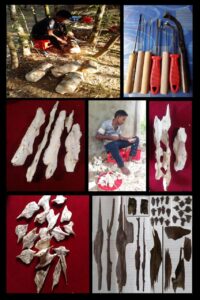
A. Oud preservation process
Tree Cutting Process:
1. Tree Cutting: When the agarwood resin (agar oud) matures inside the tree, the tree is cut down. After felling the tree, it is kept in a dry place (a warehouse or storage area) for 3 to 6 days. During this period, the moisture and sap inside the tree dry up, making the resin more visible.
2. Cutting Process: The tree, particularly the resin-containing sections, is identified and carefully cut into pieces using a special knife. Care must be taken to avoid damaging the dark resinous oud while cutting the lighter sections of the tree.
Handling of Resinous Wood:
3. Exercise Caution: When cleaning the wood with the carvings, as soon as the dark resinous wood is visible, the cutting process should be stopped. Extreme caution is needed to properly handle and preserve these resinous parts.
4. Storage in a Shaded Area: The cut pieces are stored in a shaded area for two to three days. This helps maintain the dryness of the resinous wood, making it ready for further processing.
Final Stage and Preservation:
5. Final Cleaning: Next, the pieces are further cleaned with a small tool (such as a carvi) to remove any remaining white wood or dust. At this stage, the lighter parts of the wood and debris are carefully cleaned away.
6. Preservation: Finally, after the outer parts of the Agar oud are cleaned, it is stored for sale. This entire process ensures that the Agar oud is of high quality and suitable for marketing.
In this way, the process of extracting and preserving Agar oud is completed, ensuring the resin is effectively processed and made ready for the market through proper care and quality control.
B. Identification
Laboratory Techniques and Observational Methods
Several advanced laboratory technologies and observational methods are used to distinguish between natural and artificial Agar oud. These include the following:
Laboratory Techniques
1. Gas Chromatography-Mass Spectrometry (GC-MS):
GC-MS is employed to identify the chemical components of Agar oud. By analyzing specific chemical compounds in the sample, the distinction between natural and artificial Agar oud can be determined. For instance, natural Agar oud contains high levels of volatile compounds, which can be easily detected through GC-MS. Companies like Shimadzu and Restek Corporation provide GC-MS technology.
2. Electronic Nose (E-Nose):
This technology creates a scent profile of Agar oud smoke. It utilizes Principal Component Analysis (PCA) and clustering algorithms to differentiate the scent of natural and artificial Agar oud. Natural Agar oud usually exhibits a more aromatic and complex scent profile. Companies like Alpha MOS (France) are known for E-Nose technology.
3. Static Headspace Sampling and PCA-PLS Analysis:
like SHS-GC-MS and PCA-PLS (Partial Least Squares-Discrimination Analysis) are used to separate aroma components of natural and artificial Agar oud. These methods analyze molecular-level chemical compounds and determine qualitative differences.
Notable Organizations:
Alpha MOS (France)
Specializes in electronic nose technology.
Shimadzu Corporation
(Japan) A leader in.
NIST (National Institute of
Standards and Technology):
Provides GC-MS
databases for Agar oud analysis.
Observational Methods
1. Visual Observation
Natural Agar oud:
The oud structure is irregular with cracks or asymmetric patterns.
Dark or black coloration due to fungal attack in natural conditions.
Resin is denser and unevenly distributed inside the wood.
Artificial Agar oud:
The oud structure is more uniform with controlled patterns.
Resin production is artificial, resulting in lower density and uniform coloration.
Smoother oud texture.
2. Scent Test
Natural Agar oud:
Emits a rich, deep, and complex fragrance when burned. The scent is long-lasting and combines sweetness with intensity.
Artificial Agar oud:
The scent is lighter and often monotonous. Less intense and not long-lasting.
3. Floating Test
Natural Agar oud:
High resin content sometimes causes it to sink in water.
Artificial Agar oud:
Low resin density usually keeps it floating.
4. Burn Test
Natural Agar oud:
Produces thick smoke with a lasting fragrance. Leaves black, minimal ash.
Artificial Agar oud:
Produces less intense smoke and fragrance. Leaves are white or gray ash.
5. Weight Test
Natural Agar oud:
Denser and heavier due to high resin content.
Artificial Agar oud:
Lighter and less dense.
6. Microscopic Analysis
Natural Agar oud:
Resin layers are irregular and naturally formed.
Artificial Agar oud:
Resin layers are regular, reflecting artificial processing.
7. Price Difference
Natural Agar oud is rarer and significantly more expensive. Artificial Agar oud is Comparatively cheaper.
By combining these tests and observations, it is possible to effectively distinguish
between natural and artificial Agar oud. However, for precise results, consulting an expert is recommended.
Leave a Reply